Spring '26 - Making The Scene
In a basement cavern west of Times Square, a young promoter curated the soundtrack for a Cultural Revolution.

Does it ever annoy you, Dear Reader, that corporate branding is now attached to every entertainment venue, golf tournament, arena, stadium, and 5K road race? Before corporate money washed over everything in American life, arenas and stadiums were named for their locations (Fenway Park), the teams that played in them (Yankee Stadium), the teams’ founders (Wrigley Field), or the public figures who facilitated their construction (Shea Stadium). I know I sound like cranky old Bernie Sanders, but I’m undeterred.
PGA Tour events were named after people, places, and golf clubs. There was the Sammy Davis Jr. Greater Hartford Open and the Bing Crosby Pebble Beach National Pro-Am (aka “The Crosby Clambake”). Now we have the Travelers Championship, the AT&T Pebble Beach Pro-Am, the Waste Management Phoenix Open and the Charles Schwab Challenge (Schwab!!!).
Inbound to Newark
For reasons still a mystery to me, in early 1971 my parents allowed the 15-year-old me to travel into Manhattan at night to see rock shows with my friends. I would usually return to our suburban NJ home well after midnight, but it was apparently no big deal to them. Before we had cars, our parents or older siblings would drop us off at Fanwood’s Victorian-era station on the Jersey Central Line for the train to downtown Newark.


At Penn Station Newark we’d transfer to the Port Authority Trans Hudson (PATH) train to lower Manhattan. We’d get off at the Christopher, W. 9th, or W. 14th Street stations and emerge into the glow of the bustling Greenwich Village Bohemia. There was nothing more exciting than leaving our boring suburb for Bright Lights, Big City!
In the early ‘70s, before corporate media conglomerates took over the venues, along with the radio stations and the recording industry itself, everyone knew the names of rock show promoters because they were usually attached to the venue. They may or may not have owned the real estate, but they promoted the music.
The most famous was Bill Graham’s Fillmore East at 105 Second Ave. on the Lower East Side. He was already a legendary promoter who owned The Fillmore, a psychedelic rock palace in San Francisco. The former was built in 1925 as a Yiddish theater called The Commodore, before Loews Corp. converted it to a movie palace. Graham took over and opened the now dilapidated theater as The Fillmore East on March 8, 1968. It was called “The Church of Rock and Roll," with two-show, triple-bill concerts several nights a week..


The bands playing the Fillmore East had to sign contracts prohibiting them from performing at any venue within 75 miles for four months after their show. On June 27, 1971, the Fillmore East closed with an epic show by The Allman Brothers, which ended Bill Graham’s stranglehold on rock shows in the New York area.
John Scher, a young rock promoter from West Orange, NJ, jumped on the opportunity by acquiring The Capitol Theatre in gritty Passaic, NJ and started booking the same bands that formerly played the Fillmore East. On December 16, 1971, Scher presented his first concert, the The J. Geils Band with Humble Pie, less than six months after the Fillmore East closed. Jerry Garcia played the Capitol Theatre over 40 times, either with the Grateful Dead or one of his side projects. John Scher’s Capitol Theatre was closed in1989 and demolished in 1991 and redeveloped as a mixed-use project.


Howard Stein’s Academy of Music at 146 E. 14th Street and Irving Place was our most frequent haunt for rock shows. In 1976 promoter Ron Delsener took over and renamed it The Palladium. Delsener was best known for promoting big arena shows at Madison Square Garden, the Jones Beach amphitheater, and the Wollman Skating Rink in Central Park. The former Academy of Music was purchased and demolished by NYU in 2001 for a new dorm.
The Vanguard and The Gate
By summer of 1973 I started frequenting jazz clubs, starting with The Village Vanguard, perhaps the most famous jazz club in the world. Max Gordon opened it in 1935 in a small basement at 178 Seventh Avenue South in the West Village He ran it until his death in 1989, then his wife Lorraine ran it until her death at age 95 in 2001. The first show I saw there was the Bill Evans Trio and remember being very proud of myself for coming down the basement steps and profiling my way past Mr. Gordon, who always sat at the end of the bar near the stairs. The Vanguard still books the top names in jazz, but I have not seen a show there in over 40 years. Getting back there is now on my bucket list, along with a first trip to Paris.


Later in the mid-’70s Art D’Lugoff’s Village Gate also became a favorite haunt. It was located on the prime corner of Bleecker and Thompson Streets in the heart of the Village. D’Lugoff was a true Village raconteur and held court at The Gate nightly from it’s opening in 1958 until his bankruptcy filing in 1994. I saw Larry Coryell there sometime in 1974. He was the house guitarist for a few years and known today as “The Godfather of Fusion.” Sometime in ‘74 I saw Charles Mingus’s band there and later Rahsaan Roland Kirk’s Bright Moments show.
Underage At the Village Corner
Then there was the great Village Corner at 142 Bleecker Street (corner of LaGuardia Place facing NYU), a classic dark wood and tile floor bistro with blind pianist Lance Hayward at the baby grand playing standards nitely. The bar offered then exotic beers, like Spaten Weissbier and Heineken, on tap and served them in huge pitchers. No one ever asked for IDs from us underage profilers.
Lance Hayward was an extraordinary pianist, but a dark brooding presence at the keyboard. We quickly learned never to approach the bench to request a tune for cash. Ever had a blind person glare at you from behind dark glasses? Hayward moved to Manhattan in 1966 from Bermuda, where he accompanied the likes of Marvin Gaye, Sarah Vaughn, Carmen McRae, and other greats when they visited the island. He would play nearly every week at the Village Corner for the next 16 years.
The Village Corner was closed in the late 1990s and converted first to Señor Swanky’s, a cheesy Mexican fast food joint, and then GMT, a precious bistro with cosmopolitan pretensions. See photo below with foreign flags flying above the outdoor tables. At the old Village Corner everyone sat indoors to drink and there were no flags.


The Village Corner was directly across the street from Paul Colby’s The Bitter End and The Other End at 147 Bleecker Street. They primarily featured folk music and singer-songwriters, although one night I saw the initial line-up of Chick Corea’s Return to Forever there. On another night I was about to enter the Village Corner when I saw Todd Rundgren waiting in line across the street at the The Bitter End. His hair was dyed pink and he was having an amiable chat with fans waiting with him to enter the club.
Steve Paul’s The Scene
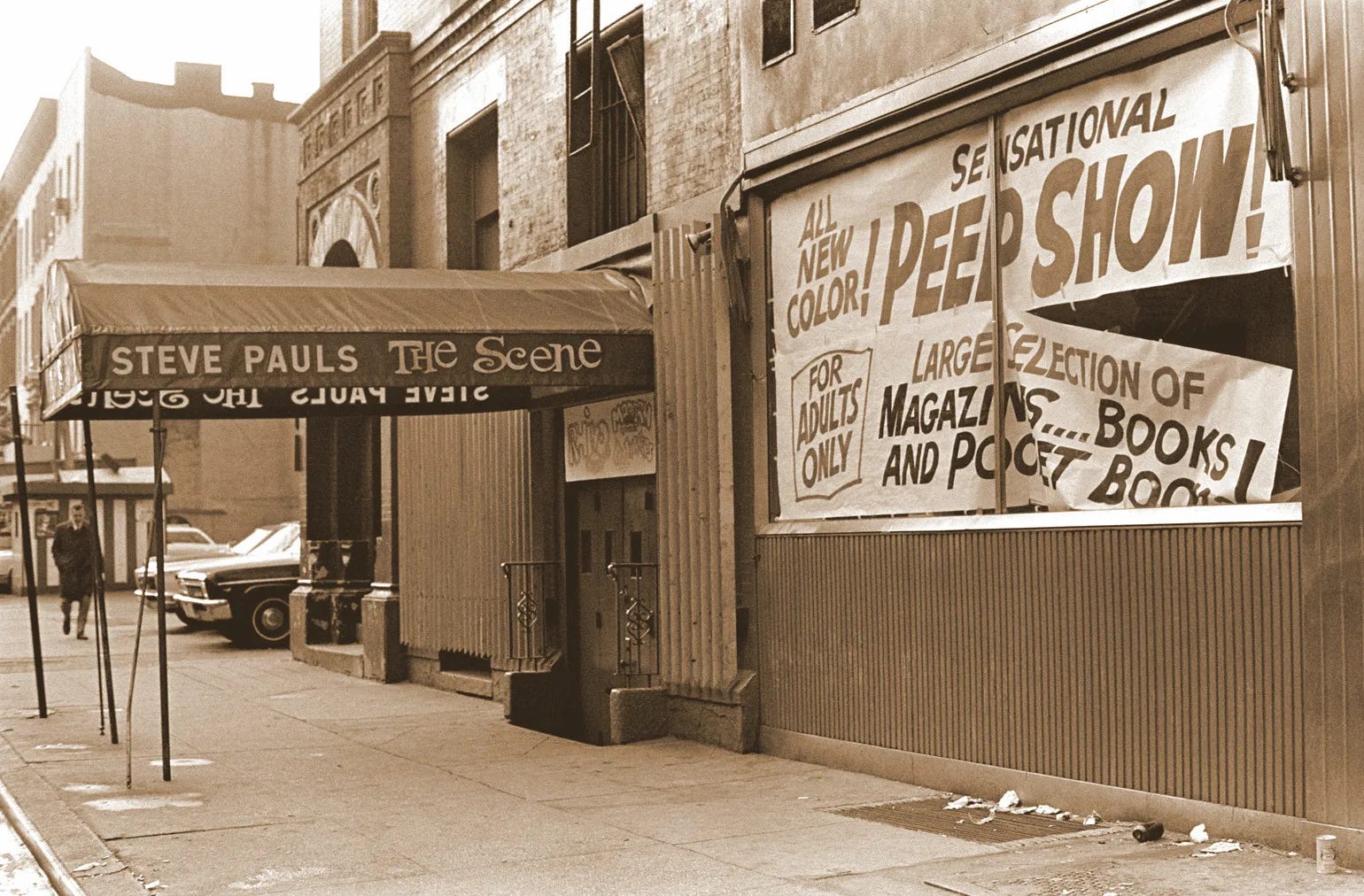
Those were just a few of my youthful haunts, but I missed out on perhaps the greatest live music “scene” in NYC rock history. In 1964 a young 22-year-old promoter named Steve Paul opened a basement club called Steve Paul’s The Scene at 301 W. 46th Street and Eighth Avenue, on the western edge of Times Square. This was the dirty, filthy, nasty old Times Square, before it was redeveloped into a Disney-like theme park for tourists. It was rife with drugs, prostitution, smut, muggers and the down and out.
Steve Paul was a publicist for the famous Peppermint Lounge when he found the 5,000 square foot basement cavern. The Scene did not begin as a dedicated rock club, but as an after-hours hangout in the Theater District for Broadway actors, dancers, producers, stagehands, and musicians. The music was mostly provided by a house pianist. It soon became a magnet for Manhattan’s cultural elite, attracting everyone from Tennessee Williams to Andy Warhol, Edie Sedgwick, and the young smart-set.


By 1966, Steve Paul shifted his focus entirely to live music, starting with New York area acts like The Lovin’ Spoonful and The Young Rascals. He had a good eye for talent and for the vibe of the cultural zeitgeist. His dream was to create “a world of reality within the world of reality.” That sounds deep, but if it’s reality within and without, isn’t it all reality? By late ‘66 his initial momentum faded and Paul closed the club temporarily.
The Scene was reopened in early 1967 with financial backing from folk singer Peter Yarrow of Peter, Paul and Mary (yes, Virginia, there was money in folk music in those days!), poet Allen Ginsberg, and fashion designer Tiger Morse. The focus was booking the emerging rock bands and singer-songwriters of the late ‘60s Cultural Revolution.


This second incarnation proved much more successful and The Scene became hipster central in New York. Steve Paul strictly controlled the door to curate a crowd of jet-setters, artists, and music industry insiders. I’d like to think this is where the term Scenester was born. You can find online many of The Scene’s concert posters and handbills like those shown above.
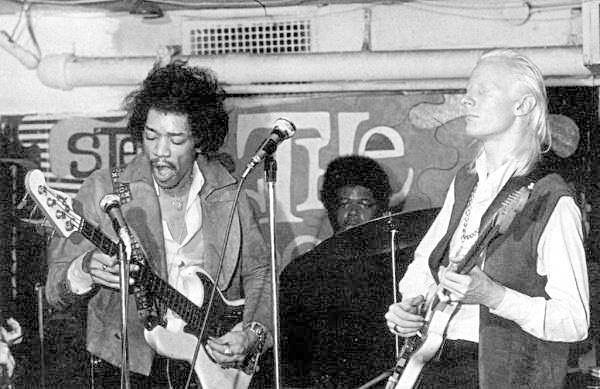
Steve Paul was prescient in booking bands just as they were breaking out. He saw Jimi Hendrix at the Monterey Pop Festival in early ‘67, then booked The Jimi Hendrix Experience for their first-ever New York performances on June 3 and 4, 1967. Hendrix loved the club’s freedom, using it to “woodshed” and join in legendary after-hours jams with everyone from Duane Allman to B.B. King to Johnny Winter. The Scene became his home base when in NYC, as it did for many other Rockstars, including the British Invasion guys like Eric Clapton, Ray Davies, Alvin Lee, Pink Floyd, Steve Winwood, Jeff Beck, and Fleetwood Mac. They could relax in the dark cavern with those of their kind without being mobbed by fans.
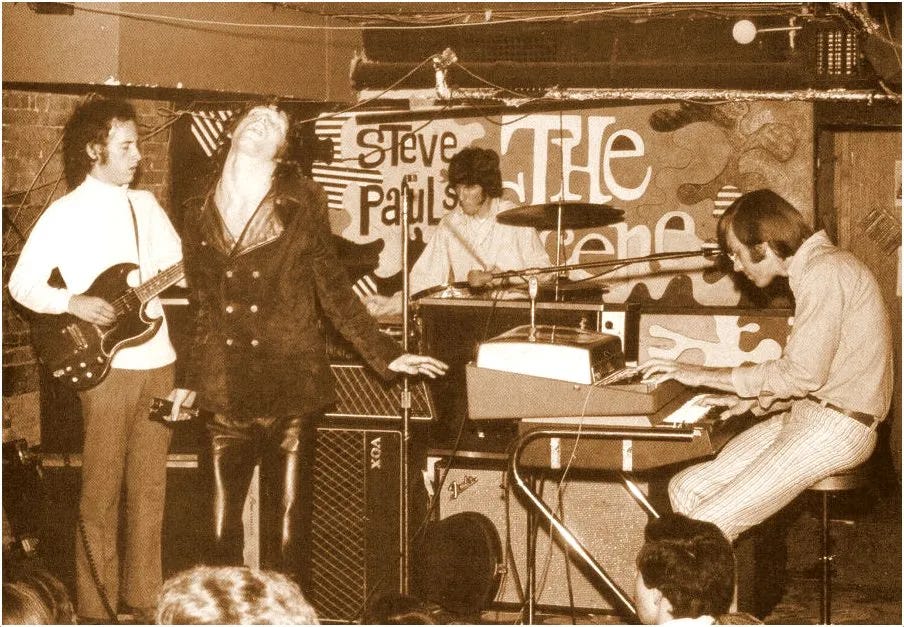
Lou Reed and the Velvet Underground on May 31, 1967 had preceded Hendrix, who was followed by Skip Spence with Moby Grape on June 8-10. Then Jim Morrison and The Doors followed on June 17 for an epic three-week stand stretching into the July 4th weekend. It was The Doors first appearance on the East Coast and coincided with their single Light My Fire rocketing to the top of the Billboard Top 100 chart. The oddball Tiny Tim opened for The Doors each night, as he did for most shows at The Scene. Steve Paul saw Tiny Tim’s genius before he starred on TV in Laugh-In.
The Psychedelic American Bandstand
Encouraged by his club’s success and filled with the youthful spirit of the emergent counterculture, Steve Paul decided to spread his message of peace, love and understanding through music to the entire nation and possibly to the world.
Paul set out to find sponsors for a syndicated musical variety show. His concept was to take Dick Clark’s stale American Bandstand format and bring it into the psychedelic late 1960s to capture the Hippie vibe of the new rock music and that of soul, R&B and folk.
Paul quickly found his sponsor in Metromedia Inc., which owned radio and TV stations across the U.S. from 1956 to 1986 (plus Orion Pictures from 1988 to 1997). It was founded in 1956 by the mogul John W. Kluge, who formed it out of the old DuMont Network, the world’s first television network. DuMont went bankrupt, ceased operations, and its TV stations were spun off into the new Metromedia.
As an interesting sidebar, the formation of Metromedia ultimately brought us the right-wing bobble heads of Fox News. In 1985 Metromedia sold its television stations to Rupert Murdoch’s News Corporation and the rest is history.
Steve Paul got the green light to produce a pilot episode of Steve Paul’s Scene and Metromedia would arrange broadcasts from its TV stations across the U.S. You can watch the entire pilot in the video below. It’s not the best quality, but is a wonderful time capsule from a Lost World. The pilot features The Blues Project, Aretha Franklin, The Staples Singers, and Moby Grape.
Steve Paul earnestly introduces each act in his gentle Noo Yawk accent and chats with the performers. He suggests the Generation Gap is a myth and that older folks are starting to dig the youthful sounds and styles. Paul is trying to reassure Middle America that they have nothing to fear in the music and the styles of long-haired electric guitarists and Black soul and gospel singers.
Aretha absolutely kills it on a cover of the Rolling Stones’ Satisfaction. Her vocal is as powerful as Mick Jagger’s original. The Blues Project jams on Wake Me, Shake Me and later on there’s a psychedelic flute interlude.
Broadcast in September 1967, the pilot of Steve Paul’s Scene turned out to be the last episode produced.
A Mobbed-Up Scene
As crowds started flocking to The Scene and it became profitable, another mob descended on the club. The New York Mafia tried to hit up Steve Paul for “protection money,” but he refused to pay them anything. The Mafioso retaliated by instigating fights inside the club and calling in the NYPD with the goal of having the club’s all-important liquor license revoked.
According to the Velvet Underground’s Sterling Morrison, the club was suddenly shutdown for good on July 12, 1969. Steve Paul decided not to pay off The Mob, but that fighting them was not worth the hassle and the danger.
Paul then decided to go into the record business and keep his staff employed by launching Blue Sky Records, which would later release comeback albums for blues legends like Muddy Waters and Johnny Winter.
After It’s Over
In thinking back on those clubs and theaters and the music I heard in those places on those nights, I feel fortunate and grateful to have lived inside that music, if just for an hour or two. I think of Eric Dolphy’s last album, Last Date, recorded live in the Netherlands just before his death on June 27, 1964. The last track, Miss Ann, ends and Dolphy speaks directly to the audience: “When you hear music, after it’s over, it’s gone in the air, you can never capture it again.”